
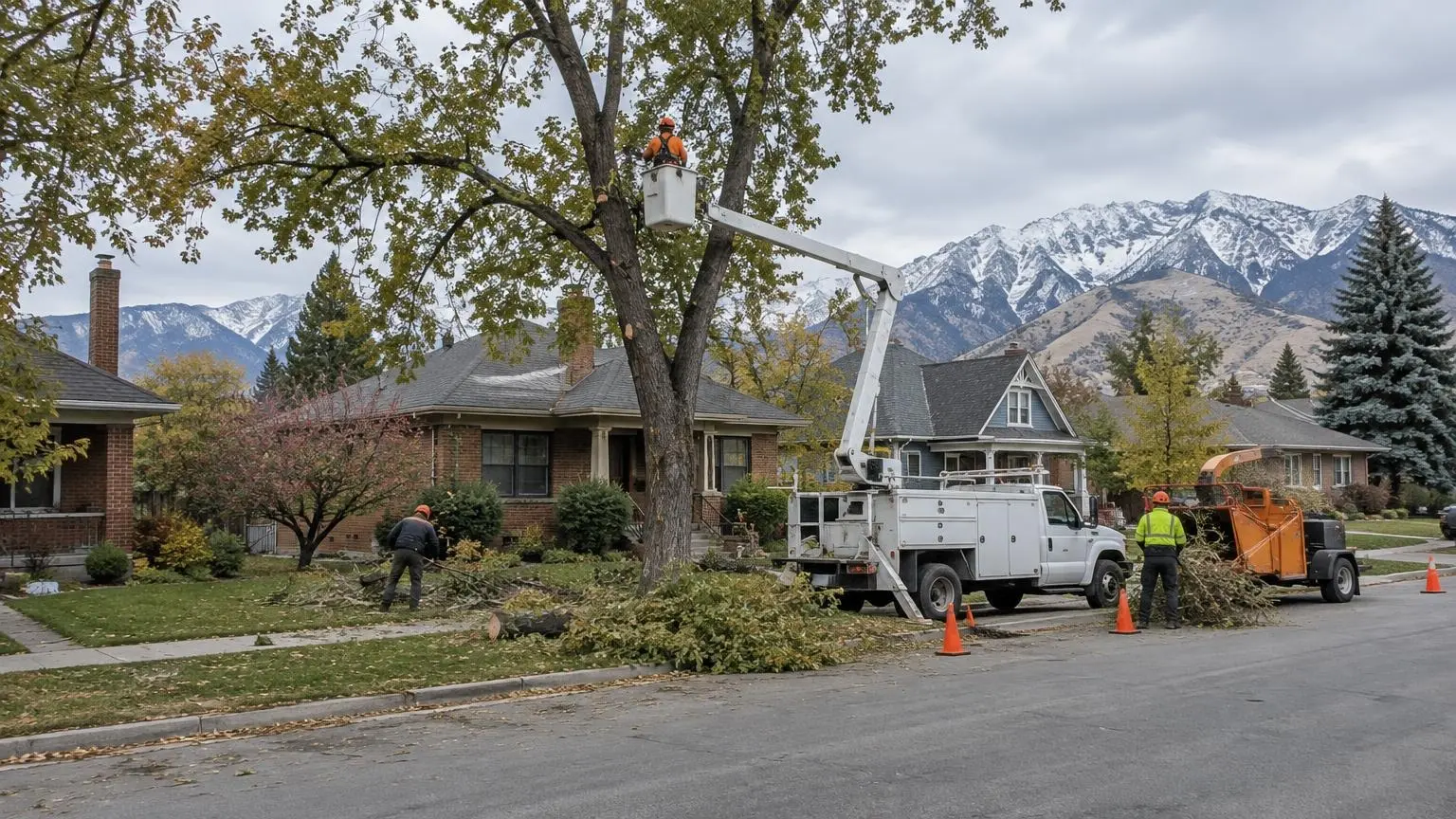
Farm country until a few decades ago
Tree Service in Riverton, UT
Canal-bank trees, leftover orchard stock and young subdivision trees on dry, open ground.
- On-site quotes at no charge in Salt Lake Valley and Salt Lake County
- Prices put in writing before the crew arrives
- Cleanup terms written into the estimate
Built on Benchland Farms
Riverton was alfalfa, wheat, sugar beets, tomatoes, poultry and dairy for most of its history, and Tree Service in Riverton still runs into that past. Three canals carried Jordan River water up onto the benchland to irrigate those farms. Where the canals and old ditch lines remain, so do the big willows, cottonwoods and box elders that grew along them. Between them sit subdivisions where the oldest tree in the yard was planted with the house.
How fast the town changed
Riverton had 1,666 people in 1950 and 11,261 in 1990. By 2000 it had 25,011, and in 2020 it had 45,285, with 13,101 housing units. A 1996 annexation nearly doubled the city's area. That growth means most yard trees in Riverton are relatively young, and the jobs we see most are:
- Structural pruning on maturing shade trees
- Removing trees planted too close to the house or under lines
- Clearing volunteer elms and Russian olive from fence lines and ditch banks
- Taking out old farm trees that are failing where new homes now stand
- Stump grinding after removals so yards can be regraded or replanted
A dry part of the valley
Riverton averages about 15.8 inches of precipitation a year. Young trees on open lots, especially ones watered only by lawn sprinklers, often grow shallow roots and suffer in hot, dry summers. Drought-stressed trees drop limbs, attract borers and decline from the top. If a tree is thinning at the crown, we look at watering and root conditions before blaming pests, and we will tell you if pruning will not help.
Settlement and name
Settlers of European descent arrived in the mid-1800s, and the town was first known as Gardnerville. It took its current name from the Jordan River, which forms its eastern edge. Electricity arrived in 1912, and an interurban rail line ran through town from 1914 to 1945. Tithing Yard Hill, named for an old church tithing storage site, is now a residential development.
A small record tree
The Utah Big Tree Directory lists Riverton for its largest recorded quince, a reminder of how many old orchard trees still stand in back corners. Fruit trees that have gone unpruned for decades can often be brought back with a few years of careful thinning rather than removed.
Young families, busy yards
The median age in Riverton was about 32 in 2020, and nearly a third of residents were under 18. Swing sets, trampolines and sandboxes end up under trees. When we prune, we pay extra attention to deadwood over play areas.
Call (385) 217-6481 or request a visit. Get a free estimate
Riverton Facts
- Canal-fed farmland. Three canals carried water from the Jordan River to Riverton's benchland, where farmers grew alfalfa, wheat, sugar beets and tomatoes and raised poultry, sheep and dairy cows.
- Rapid growth. Riverton grew from 1,666 residents in 1950 to 11,261 in 1990 and 45,285 in 2020; a 1996 annexation nearly doubled the city's size.
- Dry climate. Riverton averages about 15.76 inches of precipitation a year and sits at about 4,439 feet in the southwest corner of the Salt Lake Valley.
- Old orchard trees. The Utah Big Tree Directory lists Riverton for its largest recorded quince.
Riverton Questions
Can an old fruit tree that hasn't been pruned in years be saved?
Often, yes. We remove deadwood and thin over two or three seasons instead of cutting it all back at once, which would trigger a flush of weak sprouts. If the trunk is badly decayed, removal may make more sense.
Why is my young shade tree dying back from the top?
In Riverton, drought stress is a common cause, especially for trees watered only by lawn sprinklers. Borers often follow stress. Deep, slow watering helps; pruning out the dead top only helps once the cause is addressed.
Can you clear volunteer trees along a ditch behind my yard?
Yes, on your side of the line. Ditch banks are often controlled by an irrigation company, so we ask about access first and keep debris out of the water.
How close to the house can a tree safely grow?
It depends on the species. A large shade tree planted five feet from the foundation will eventually crowd the roof and gutters, and its roots will compete with the footing and sprinkler lines. Smaller ornamentals can sit closer. If a young tree is clearly in the wrong spot, moving or removing it now is far cheaper than later.
Do you haul everything away after a removal?
Yes, unless you ask us to leave chips or firewood. The written estimate states what is chipped, what is hauled and how the work area will be left, so you know what to expect when the crew pulls away.
Free Estimates in Riverton, UT
Free estimates across Riverton, from the Jordan River to the west-side neighborhoods.
Tree Service Near Riverton
- Tree Service in Salt Lake City, UT
- Tree Service in Millcreek, UT
- Tree Service in Holladay, UT
- Tree Service in Cottonwood Heights, UT
- Tree Service in Murray, UT
- Tree Service in Sandy, UT
- Tree Service in Draper, UT
- Tree Service in South Salt Lake, UT
- Tree Service in Midvale, UT
- Tree Service in Taylorsville, UT
- Tree Service in West Valley City, UT
- Tree Service in West Jordan, UT
- Tree Service in South Jordan, UT
- Tree Service in Herriman, UT
- Tree Service in Bluffdale, UT
- Tree Service in Kearns, UT
- Tree Service in Magna, UT
- Tree Service in Emigration Canyon, UT
- Tree Service in Bountiful, UT
- Tree Service in Centerville, UT
- Tree Service in Farmington, UT
- Tree Service in Kaysville, UT
- Tree Service in North Salt Lake, UT
- Tree Service in Woods Cross, UT
- Tree Service in West Bountiful, UT