
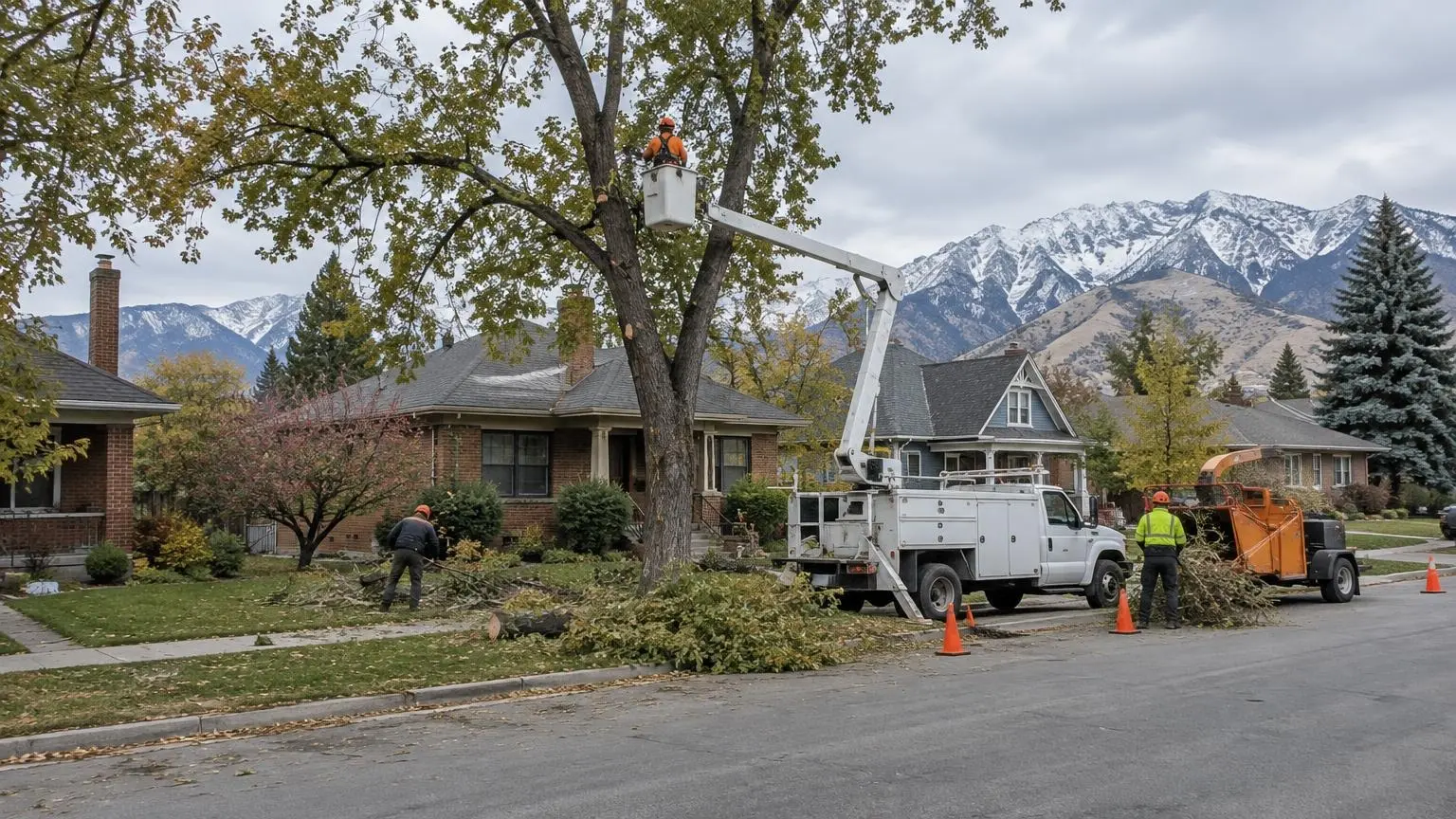
From about 4,200 people in 1970 to nearly 117,000
Tree Service in West Jordan, UT
Older trees near the river, young landscapes toward the Oquirrhs, and plenty of Russian olive in between.
- On-site quotes at no charge in Salt Lake Valley and Salt Lake County
- Prices put in writing before the crew arrives
- Cleanup terms written into the estimate
Fifty Years of Growth, Fifty Years of Trees
West Jordan had about 4,200 residents in 1970 and nearly 117,000 in 2020, which makes Tree Service in West Jordan a mix of very different jobs. Neighborhoods built in the 1970s and 1980s have trees that are now large and aging. Subdivisions from the 2000s and 2010s have trees just reaching the size where structural pruning matters most. And along canals, washes and the Jordan River, there is volunteer growth nobody planted.
Russian olive and other volunteers
The Utah Big Tree Directory lists West Jordan as the location of its largest recorded Russian olive. Russian olive is tough, thorny and spreads readily along water, and it is widely considered invasive in the West. On many West Jordan lots it shows up along back fences and ditch banks, along with Siberian elm and tree-of-heaven seedlings. If you want those gone, we cut them and grind or treat the stumps so they do not sprout back from the roots.
Stages of a growing city
- 1970s-80s neighborhoods: big shade trees over roofs, roots in driveways, and some trees past their prime
- 1990s-2000s subdivisions: maturing trees that need their first serious pruning
- Newest areas toward the Oquirrhs: young trees that benefit from training cuts and correct staking removal
The same visit can cover several of those, and the estimate will itemize each tree.
A long history with timber
Archibald Gardner built one of the area's first sawmills here in 1850, and his mill buildings are now part of Gardner Village. The city was settled in 1848 and incorporated on January 10, 1941. Its name comes from the Jordan River, which settlers called the Western Jordan, and the river still forms the city's eastern boundary while the Oquirrh Mountains form the western.
Owners and homes
Census figures put West Jordan's owner-occupied rate around 77 percent and its median home value near $492,500, across about 36,700 households. Most calls we get are from owners planning ahead: a tree that has grown over the roof, a stump left from a storm, or a row of overgrown evergreens along the property line.
Wind from the west
Newer subdivisions on the city's west side sit on more open ground with fewer mature trees to break the wind. Young trees there tend to lean or grow lopsided. We correct that with pruning while the trees are small, and we take off old stakes and ties that are cutting into the bark.
Call (385) 217-6481 or send the form. Get a free estimate
West Jordan Facts
- Record Russian olive. The Utah Big Tree Directory lists West Jordan for its largest recorded Russian olive, as well as its largest Japanese plum, southwestern white pine and yellowhorn.
- Rapid growth. West Jordan grew from 4,221 residents in 1970 to 42,892 in 1990, 103,712 in 2010 and 116,961 in 2020, making it Utah's third most populous city.
- Gardner's sawmill. Archibald Gardner built one of the area's first sawmills in 1850; his mills and houses now form Gardner Village. The city incorporated on January 10, 1941.
- Homes and owners. Census QuickFacts reports a 77.2% owner-occupied rate and a $492,500 median home value across 36,722 households for 2020-2024.
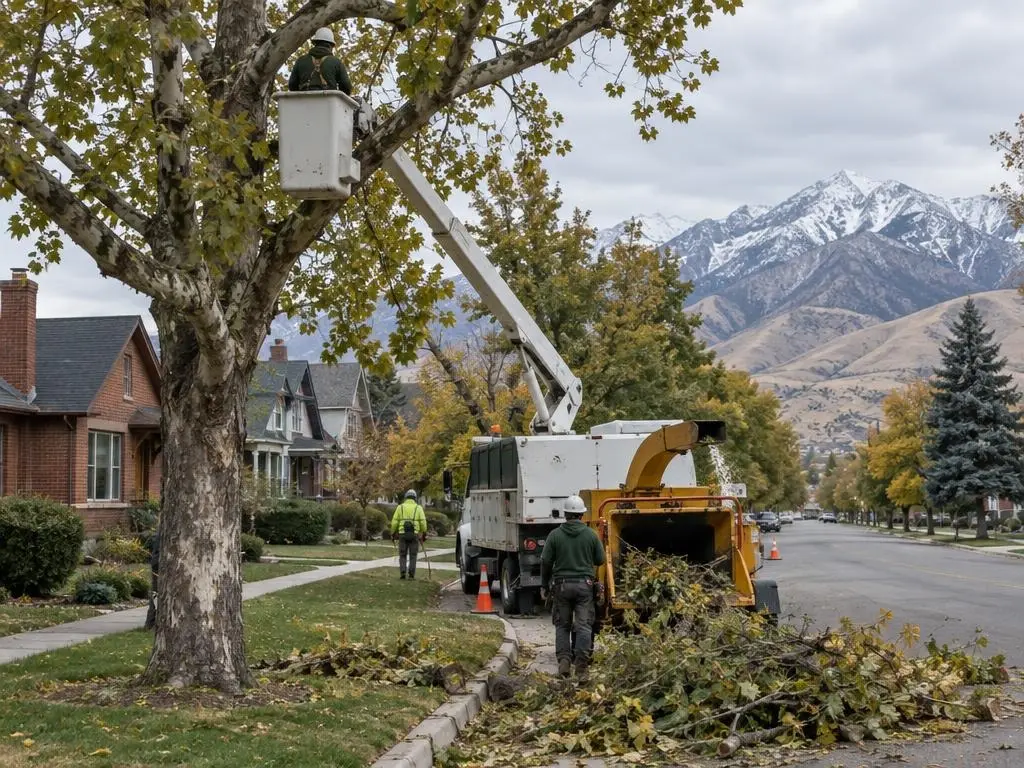
Our Services in West Jordan, UT
West Jordan Questions
How do I keep a Russian olive from coming back after it is cut?
Russian olive resprouts from stumps and roots. Grinding the stump well below grade helps, and some owners also have the fresh cut treated. Expect to pull or cut a few sprouts the first season either way.
My new-construction trees are leaning. Should they still be staked?
Most young trees should have their stakes removed after a year or two. Ties left on too long girdle the trunk. We can remove old stakes and prune the tree so it grows upright on its own.
Do you take out overgrown evergreens along a property line?
Yes. Rows of overgrown spruce, juniper or arborvitae are common removals. We cut them, grind the stumps and haul everything away, so the area is ready for new planting or fencing.
Can you remove a tree near a canal or ditch behind my yard?
Often yes, but canal and ditch banks are usually controlled by an irrigation company, and access or work on the bank may need their okay. We will ask about it during the visit and keep debris out of the water during the job.
What happens to the wood after a removal?
Unless you ask to keep it, branches are chipped and the trunk wood is hauled away. If you want rounds left for firewood or chips left for mulch, say so and it goes into the written estimate.
Free Estimates in West Jordan, UT
Free estimates across West Jordan, from the Jordan River to the Oquirrh foothills.
Tree Service Near West Jordan
- Tree Service in Salt Lake City, UT
- Tree Service in Millcreek, UT
- Tree Service in Holladay, UT
- Tree Service in Cottonwood Heights, UT
- Tree Service in Murray, UT
- Tree Service in Sandy, UT
- Tree Service in Draper, UT
- Tree Service in South Salt Lake, UT
- Tree Service in Midvale, UT
- Tree Service in Taylorsville, UT
- Tree Service in West Valley City, UT
- Tree Service in South Jordan, UT
- Tree Service in Riverton, UT
- Tree Service in Herriman, UT
- Tree Service in Bluffdale, UT
- Tree Service in Kearns, UT
- Tree Service in Magna, UT
- Tree Service in Emigration Canyon, UT
- Tree Service in Bountiful, UT
- Tree Service in Centerville, UT
- Tree Service in Farmington, UT
- Tree Service in Kaysville, UT
- Tree Service in North Salt Lake, UT
- Tree Service in Woods Cross, UT
- Tree Service in West Bountiful, UT